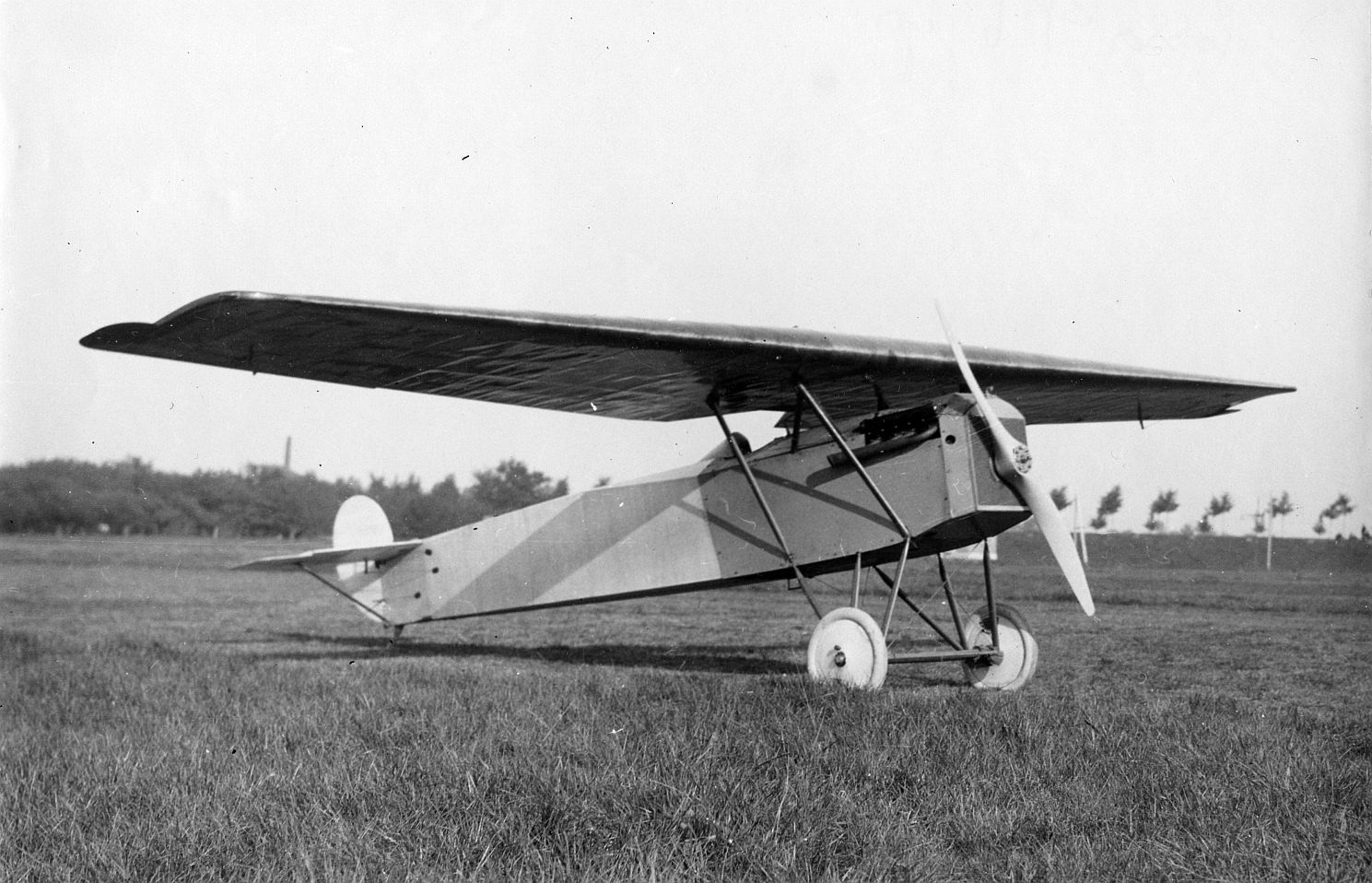
The Fokker F.VI (PW-5)
Another type Anthony Fokker was commissioned to build during his first visit to America was the ‘Armed Combat Monoplane’, with two aircraft ordered. These were also intended for the Army Air Service.
For reasons that remain unclear, the type was designated V.40 (even in America). At Veere, where Platz built the aircraft, they were called F.VI. They can be considered a development of the German V.37.
Did Fokker mistakenly designate it V.40, or was he trying to throw the Allies in Germany off the scent?
The fact is that they seized the real V.40 (a small sports aircraft) as an illegally built military aircraft.
The two F.VI aircraft were shipped from Antwerp to America on 26 November 1921. They were assigned registrations AS 64231 and AS 64232, and the first was put through its paces at McCook Field.
Although the armour plating was soon replaced with plywood, the aircraft’s performance was well received. So much so that negotiations began for a follow-up order for ten aircraft and two metal wings.
Disaster struck on 13 March 1922. During a mock dogfight over McCook Field with a PW-2, part of the AS64231’s wing broke off. The pilot, Lt Niedermeyer, did not survive the crash.
Investigations into the cause followed, but the accident was not explained until several years later, when it was attributed to ‘wing flutter’. At the Army Air Service’s direction, the wings of the ten aircraft subsequently purchased as PW-5s were strengthened.
By the end of 1922, the ten PW-5s built in Amsterdam were ready to be shipped.
Two (AS68547 and AS 68554) went to McCook Field, while the rest were sent to Selfridge Field for operational testing with the 27th Pursuit Squadron. AS68547 was transferred there shortly afterwards as well.
Aileron flutter was also detected during testing there, but was remedied by tightening the aileron cables. At the end of the test period in May 1923, two aircraft were transferred to Ft. Riley and seven to Kelly Field.
Investigations into the wing vibrations continued, with the engine mounts also briefly blamed.
For safety reasons, this led to the type being withdrawn from service in August 1923.
Only AS68554 at McCook Field continued to be used for limited testing, until January 1926.
Fokker blamed the Army Air Corps for the aircraft’s safety problems. In his view, they had ruined it with the modifications they demanded. Development of the type continued with the D.X.
Click the photo to enlarge